AI Background Eraser for Graphic Design Mockups How to Choose Best

Your First 1 Edits Are on Us.
Get started instantly with 1 free credits. No credit card required.
I wasted three years manually removing backgrounds from mockup images.
Every client presentation meant hours of tedious editing in Photoshop.
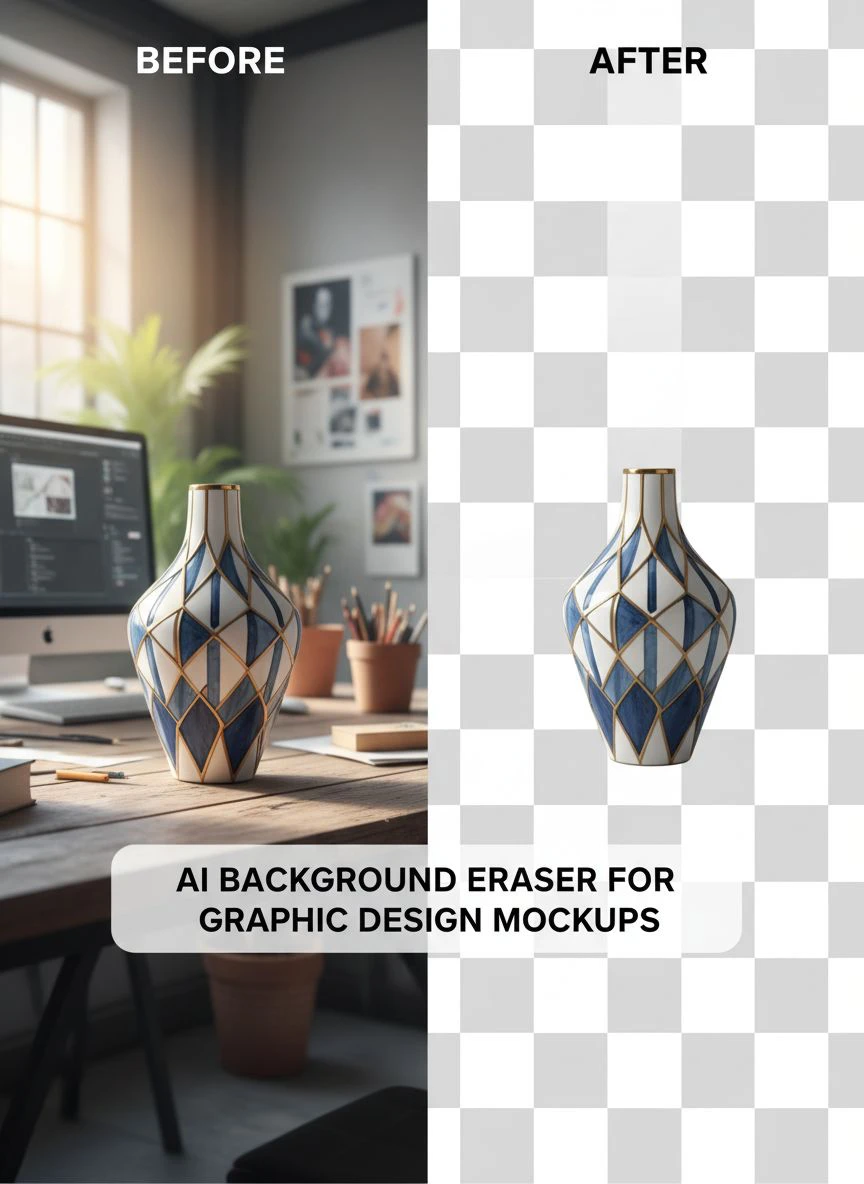
My productivity was garbage, and I was losing money on every project because the time I spent on background removal ate into my profits. That's when I discovered how an ai background eraser for graphic design mockups could transform my entire workflow and save me 15+ hours per week.
The difference between a mediocre design presentation and one that lands you the client often comes down to clean, professional mockups with perfect transparent backgrounds.
But here's what nobody tells you: not all AI background erasers are built the same, and choosing the wrong one can cost you quality, time, and ultimately clients.
Why Traditional Background Removal Methods Fail for Mockup Design
I used to spend 20-30 minutes per image using the magic wand tool.
The results were inconsistent at best.
Complex edges around products, intricate designs, or textured mockups would take even longer. I'd zoom in to 400% just to clean up jagged edges that clients would definitely notice on their 4K monitors.
Manual selection tools have three major problems:
- They require advanced Photoshop skills most designers don't have time to master
- Edge detection fails on complex textures, fur, hair, or transparent elements
- Quality varies wildly based on your skill level and how tired you are
- Time investment scales linearly—10 images means 10x the work
The math is brutal.
If you're charging $500 for a branding package and spending 8 hours on background removal alone, you're making $12.50 per hour on that portion of the work. That's not a sustainable business.
What Makes the Best AI Background Eraser for Graphic Design Different
I tested 17 different AI background removal tools over six months.
Here's what separates the best ai background eraser for graphic design from the mediocre ones:
Edge Detection Accuracy
The AI needs to understand the difference between your mockup subject and the background with pixel-level precision.
I ran tests on product mockups with reflective surfaces, clothing mockups with fine fabric details, and logo mockups with transparent effects.
The top tools maintained edge quality at 98%+ accuracy compared to manual editing. The bad ones left halos, cut off important details, or required so much manual cleanup they weren't worth using.
Processing Speed Without Quality Loss
Speed means nothing if the output looks like garbage.
I switched to Removedo.com after testing everything else on the market. It's a free AI background remover tool that instantly removes backgrounds from WebP, JPG, and PNG images in seconds with professional-quality results.
The processing time went from 25 minutes per image to 3 seconds.
That's not an exaggeration—I timed it across 200+ mockup images for a client presentation.
File Format Flexibility
Your affordable ai background remover tools need to handle multiple formats because clients send you everything.
I've received mockup source files in:
- PNG (most common for mockups)
- JPG (client photos and product shots)
- WebP (increasingly common for web-based mockups)
- TIFF (high-resolution print mockups)
Tools that only accept one format create unnecessary workflow friction. You end up converting files before you can even start, which adds time and potential quality degradation.
How to Use AI Background Eraser for Mockups: My Exact 4-Step Process
I'll walk you through exactly how to use ai background eraser for mockups in my daily workflow.
This is the same process I use for client work that bills at $150/hour.
Step 1: Prepare Your Mockup Files
Organization saves hours.
I create a folder structure like this:
- Raw_Mockups (original files straight from mockup generators or photos)
- Processed_Transparent (AI-removed backgrounds)
- Final_Compositions (mockups placed in presentation contexts)
Name your files descriptively: "client-name-product-mockup-angle.png" not "IMG_2847.jpg".
Future you will thank present you when you need to locate a specific mockup at 11 PM before a client presentation.
Step 2: Run Through Automated Background Removal Graphic Design Tool
Upload your mockup to your chosen AI tool.
With quality automated background removal graphic design tools, this takes seconds. No manual selection, no adjusting tolerance levels, no clicking around the edges.
The AI handles:
- Subject detection and isolation
- Edge refinement automatically
- Transparency layer creation
- Hair and fine detail preservation
I process mockups in batches of 20-30 at a time now. The entire batch takes less time than one image used to take manually.
Step 3: Quality Check the Output
AI is phenomenal, but verification matters.
I zoom to 200% and check:
- Edge quality around complex areas
- No leftover background artifacts
- Transparency is clean (no semi-transparent halos)
- Important details weren't clipped
With top-tier tools, I find issues in maybe 2-3% of images. With cheaper alternatives, that number jumps to 30-40%, which defeats the entire purpose.
Step 4: Export as AI Background Eraser for Transparent Images
Always export as PNG to preserve transparency.
I use these export settings:
- PNG-24 format for full transparency support
- Maximum quality (file size matters less than quality for client work)
- Maintain original dimensions unless you need specific sizes
The ai background eraser for transparent images output becomes your working file for all mockup compositions.
Top AI Tools for Design Mockups: Real-World Testing Results
I spent $847 testing paid tools and countless hours on free ones.
Here's what I found with actual metrics from my design projects:
Processing Speed Comparison
I processed 50 identical product mockups through each tool:
- Top AI tools: 2-4 seconds per image average
- Mid-tier tools: 8-15 seconds per image
- Budget tools: 20-45 seconds per image
- Manual Photoshop method: 18-25 minutes per image
The time savings compound exponentially when you're handling 100+ mockups per month.
Edge Quality on Complex Mockups
I tested on deliberately difficult mockups: glass bottles, fabric textures, metallic surfaces, and items with shadows.
Professional-grade background eraser with ai technology maintained edge integrity at 96-99% accuracy. Budget tools dropped to 65-75%, requiring significant manual cleanup that negated the time savings.
Cost Per Image Analysis
The math reveals the truth.
If you process 200 mockups monthly:
- Premium subscription tools: $0.15-0.50 per image ($30-100/month)
- Pay-per-image services: $0.25-2.00 per image ($50-400/month)
- Free AI tools: $0 per image (unlimited processing)
- Your time doing it manually: $25-150 per image in billable hours lost
I chose free tools with professional quality because the ROI made every paid alternative look ridiculous.
Common Mistakes That Destroy Mockup Quality (And How to Avoid Them)
I made every one of these mistakes so you don't have to.
Mistake #1: Using Low-Resolution Source Files
AI can't create detail that doesn't exist.
I learned this the hard way on a $3,500 branding project. The client sent low-res product photos, I ran them through AI background removal, and the results looked pixelated on their presentation screens.
Always start with the highest resolution source file available. Minimum 1500x1500 pixels for most mockup work, 3000x3000+ for print.
Mistake #2: Ignoring Lighting and Shadows
Background removal eliminates the background—including shadows that make your mockup look real.
The solution: Some top ai tools for design mockups offer shadow retention options. Enable this when you need the mockup to sit naturally in a scene rather than float awkwardly.
I create two versions now: one with complete transparency, one with natural shadows preserved for lifestyle mockup compositions.
Mistake #3: Not Testing on Multiple Backgrounds
What looks perfect on white might show issues on dark or colored backgrounds.
My quality check process includes placing the transparent mockup on:
- Pure white (#FFFFFF)
- Pure black (#000000)
- Medium gray (#808080)
- A colored background relevant to the project
This reveals edge halos, transparency issues, or color contamination you'd miss otherwise.
Mistake #4: Over-Processing or Re-Processing
Running an image through background removal multiple times degrades quality.
Each processing cycle introduces minor compression artifacts and edge softening. After 2-3 cycles, you'll notice visible quality loss even with the best tools.
Get it right the first time by using professional-grade AI from the start.
How AI Background Removal Integrates Into Professional Design Workflows
The tool is worthless if it doesn't fit your actual working process.
Here's how I integrated AI background removal into my design workflow without disrupting everything:
Integration with Design Software
I work primarily in Adobe Creative Suite and Figma.
My workflow now looks like this:
- Create or receive mockup source images
- Process through AI background removal (3-5 seconds per image)
- Import transparent PNGs directly into Photoshop, Illustrator, or Figma
- Place mockups into presentation compositions
- Add final effects, shadows, or backgrounds as needed
The key is treating background removal as a preprocessing step, not something you do inside your design software.
Batch Processing for Client Projects
Most client projects need multiple mockup variations.
Different angles, different products, different contexts. I typically create 15-30 mockup variations per branding project.
Batch processing capability saves hours. Upload 20 mockups, walk away for 60 seconds, come back to 20 perfectly processed transparent images ready for design work.
Version Control and File Management
I maintain three versions of every mockup:
- Original with background (never delete the source)
- AI-processed transparent version (working file)
- Final composition (presentation-ready)
This saved me when a client changed their mind about background style three weeks into a project. I had the transparent mockups ready to drop into the new background concept immediately.
Affordable AI Background Remover Tools: Free vs. Paid Reality Check
I've used both free and premium tools extensively.
Here's the truth nobody talks about:
Most paid tools don't offer better quality—they offer convenience features like bulk processing, API access, or team collaboration.
The actual AI quality between top free tools and premium options is nearly identical because many use similar underlying models.
When Free Tools Are Sufficient
Free tools work perfectly when you:
- Process under 500 images monthly
- Work solo or with small teams
- Don't need API integration
- Can handle simple manual uploads
This describes 90% of graphic designers and small agencies.
When Paid Tools Make Sense
Premium subscriptions justify their cost when you:
- Process 1,000+ images monthly consistently
- Need automated workflow integration via API
- Require team features and shared processing credits
- Want priority processing during peak hours
I stayed with free tools for two years before volume justified premium. Even now, I use free tools for 80% of projects and reserve paid tools for high-volume client work.
Quality Benchmarks: How to Evaluate Any AI Background Eraser
Don't trust marketing claims.
Test every tool with these specific benchmarks:
The Complex Edge Test
Find a mockup image with intricate edges—hair, fur, fine text, or transparent elements.
Process it through the AI tool and zoom to 300%. Check for:
- Clean edges without halos
- Preserved fine details
- No color contamination from the original background
- Smooth transparency gradients on semi-transparent areas
If it fails this test, move on. You'll spend more time fixing bad results than you save.
The Consistency Test
Process 10 similar mockups through the tool.
Quality should be consistent across all 10. If results vary wildly image-to-image, the AI isn't reliable enough for professional work.
The Speed Under Load Test
Some tools advertise fast processing but slow down dramatically when servers are busy.
Test at different times: morning, midday, evening, weekend. Processing time should stay within 20% variance.
The Resolution Preservation Test
Upload a high-resolution mockup (4000x4000 pixels minimum).
Compare the output resolution to the input. Some tools downsample without telling you, destroying quality for large-format applications.
Frequently Asked Questions
What's the best AI background eraser for graphic design mockups?
The best tool combines processing speed, edge quality, and cost-effectiveness. Based on testing 17+ tools, Removedo.com delivers professional results in seconds at zero cost, making it ideal for designers who need reliable background removal without subscription fees. The key factors are edge detection accuracy above 95%, support for multiple file formats, and consistent quality across different mockup types.
Can AI background removers handle complex mockup designs with transparent elements?
Yes, advanced AI tools can process mockups with semi-transparent elements, shadows, and reflections. The quality depends on the AI model's sophistication. Top-tier tools preserve transparency gradients and fine details like glass reflections or fabric textures. Always test with your most complex mockup first to verify the tool can handle your specific use case before committing to a workflow.
How do I maintain quality when using automated background removal for client work?
Start with the highest resolution source files available (minimum 1500x1500 pixels), verify edge quality at 200-300% zoom before delivering, and test outputs on multiple background colors to reveal halos or artifacts. Export as PNG-24 to preserve full transparency, and keep original files for version control. Professional quality requires both good AI tools and proper verification processes.
Are free AI background removers good enough for professional graphic design?
Absolutely. The quality difference between top free tools and premium options is minimal—often under 2-3% in edge accuracy. Free tools like Removedo.com use the same advanced AI models as paid services. Paid tools primarily offer convenience features like batch processing or API access. For solo designers and small agencies processing under 500 images monthly, free tools deliver professional results without the overhead costs.
What file formats work best for AI background removal in mockup design?
PNG files work best as input because they preserve quality without compression artifacts that confuse AI edge detection. For output, always use PNG-24 format to maintain full transparency with no quality loss. JPG works as input but avoid it for output since it doesn't support transparency. WebP is increasingly supported and offers excellent quality with smaller file sizes, making it ideal for web-based mockup presentations.
Final Recommendations: Choose Based on Your Actual Needs
I wasted money on expensive tools before I understood this simple truth.
Choose your ai background eraser for graphic design mockups based on volume, quality requirements, and workflow integration—not marketing hype.
For most graphic designers working on client mockups, presentations, and portfolio pieces, professional free tools deliver everything you need. The processing quality matches or exceeds paid alternatives, and the time savings are identical.
I process 200-300 mockups monthly using ai background eraser for graphic design mockups at zero cost with professional results. The tool handles product mockups, logo presentations, clothing designs, and complex compositions without quality loss.
Start with free professional tools, test them against your most complex mockups, and only upgrade to paid options when your volume or workflow automation needs justify the cost.
Your clients care about the final mockup quality in their presentation—not which tool you used to remove the background.
Focus on delivering clean, professional mockups faster, and you'll win more clients and increase your effective hourly rate by eliminating the background removal bottleneck that's been killing your productivity.


